The Happy Passion by Anthony James
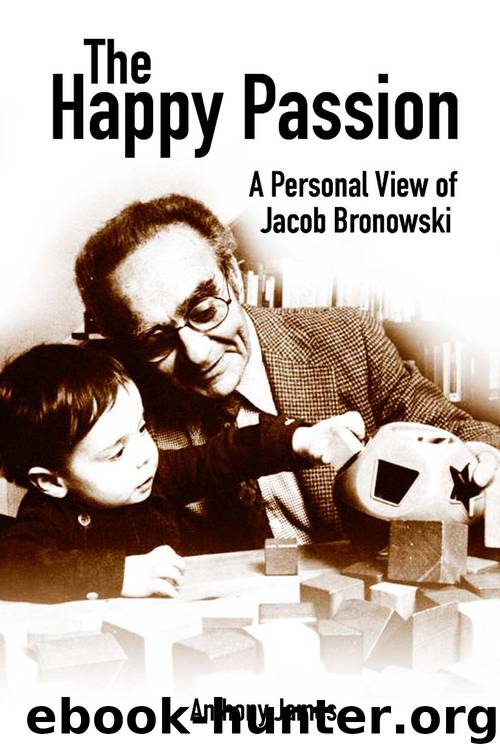
Author:Anthony James
Language: eng
Format: epub
Tags: Bronowski, science, philosophy, drama, poetry, biography, culture, Ascent of Man, evolution, Auschwitz, politics, knowledge
ISBN: 9781845408602
Publisher: Andrews UK Ltd.
Published: 2017-01-31T05:00:00+00:00
Science and Human Values (1956)
The style of this book is more playful, more sad, even bitter, and certainly more personal than The Common Sense of Science. This may be due to the fact that the three chapters that make up Science and Human Values were originally given as lectures at the Massachusetts Institute of Technology in February and March 1953 when Bronowski was a visiting professor there. In the first chapter Bronowski expands on the theme of science as a creative act of the imagination. For myself, I remember buying, at the age of fourteen or fifteen, before I ever watched The Ascent of Man, a book by A.E. Trueman called Geology and Scenery in England and Wales in which the author insisted that the geologist must have an eye and imagination equal to that of the artist and the poet. At the time, of course, I found that statement difficult to swallow; although I was certainly interested in geology, I couldn’t quite believe that it was comparable to poetry - which, at the time, I was trying hard to write. Now, after a lifetime of being influenced by Bronowski’s thinking, I don’t find the statement at all difficult to accept. Scientific laws and concepts begin with a courageous guess, and the guess is directed towards finding likeness behind appearances that have suggested that there is no likeness at all. They certainly do not begin with piling up mounds of facts and observations. In 1543 someone brought Copernicus, who was probably dying, the first printed copy of the book he had written more than a decade earlier in which he stated the thesis that the Earth moves around the sun. ‘When did Copernicus go out and record this fact with his camera?’ Bronowski asks. ‘What [...] prompted his outrageous guess? [And how] is this guess to be called a neutral record of fact?’ Kepler used metaphors and other analogies such as relating the speeds of the planets to musical intervals in searching for his laws of planetary motion, and in the twentieth century Niels Bohr and Ernest Rutherford made an imaginative leap and found a model for the structure of the atom in the orbit of the planets round the sun. And Newton, sitting in his mother’s garden and watching apples fall from the tree to the ground, imagined the same force of gravity that makes the apple fall stretching out into space and keeping the Moon and the planets in their orbits. The falling apple and the Moon seem astonishingly unlike each other, but Newton found a new likeness, just as a poet does. A good or great piece of poetry is striking because it makes new connections between the elements of reality. In Romeo and Juliet we find the line ‘Death that hath sucked the honey of thy breath’ spoken when Romeo finds Juliet and thinks that she is dead. Shakespeare rearranges the elements we expect to find in the world - not only has Death stung Juliet
Download
This site does not store any files on its server. We only index and link to content provided by other sites. Please contact the content providers to delete copyright contents if any and email us, we'll remove relevant links or contents immediately.
Hit Refresh by Satya Nadella(9093)
When Breath Becomes Air by Paul Kalanithi(8386)
The Girl Without a Voice by Casey Watson(7855)
A Court of Wings and Ruin by Sarah J. Maas(7760)
Do No Harm Stories of Life, Death and Brain Surgery by Henry Marsh(6917)
Shoe Dog by Phil Knight(5232)
A Higher Loyalty: Truth, Lies, and Leadership by James Comey(4926)
The Rules Do Not Apply by Ariel Levy(4922)
Hunger by Roxane Gay(4902)
Tuesdays with Morrie by Mitch Albom(4741)
Everything Happens for a Reason by Kate Bowler(4708)
The Immortal Life of Henrietta Lacks by Rebecca Skloot(4561)
Millionaire: The Philanderer, Gambler, and Duelist Who Invented Modern Finance by Janet Gleeson(4432)
How to Change Your Mind by Michael Pollan(4325)
All Creatures Great and Small by James Herriot(4286)
The Money Culture by Michael Lewis(4150)
Man and His Symbols by Carl Gustav Jung(4108)
Elon Musk by Ashlee Vance(4097)
Tokyo Vice: An American Reporter on the Police Beat in Japan by Jake Adelstein(3959)
